Down comforters are one of most luxurious yet practical household items. The special warmth and softness of the best down comforters symbolize hearth and home for many. Quality matters a lot with these wonderful blankets, because a lot can go wrong. The down can be wispy or clumped or under-stuffed; it can poke you with quills. The baffles can tear, and there may be pockets without stuffing at all. It might smell.
There’s a worldwide market in down comforters, so plenty of real value is out there. You just need to wind your way around the marketing to the right materials and construction. You can spend many hundred of dollars for handpicked downy clusters–and they can be worth it–but you can find suprising quality for much, much less.
In this article, we’ll go over the features of a quality comforter, and review a selection of top high-value models currently on the market.
OKAY, BUT WHAT IS A DOWN COMFORTER?
Comforters are likely named for the feeling you get when nestled in layers of soft down. Down is the innermost soft, wispy feather-hair under a bird’s hard outer feathers, and as a filler it makes an amazingly soft and warm blanket. Real down comforters are made of down from geese or ducks.
Comforters made from down are lightweight in relation to the amount of insulation they provide when fluffed. Synthetic insulation has come a long way in recent years, but natural down is still the lightest and warmest insulation available.
BEST DOWN COMFORTERS BUYER’S GUIDE
PROPERTIES OF DOWN
Down is a special kind of feather designed by Nature to keep birds warm—and it does just as well for people. Down forms a fluffy layer beneath the outer feathers, trapping air and body heat efficiently to provide the world’s best thermal insulation. The bottom layer of down contains the puffiest feathers, called clusters, that are typically mixed into high-end filling for extra loft.
Loft provides insulation as well as fluffiness. A down’s loft is measured as Fill Power (FP): the volume occupied by an ounce of down fiber under standardized pressure.
Both duck and goose down is used for consumer comforters. Duck down is smaller and generally provides less loft and insulation than goose down.
FILL POWER
Down is graded by Fill power (FP). This is typically noted somewhere on the comforter and its packaging. Fill Power ranges from a low of 500 to a high of 900.
700+ FP ratings are given to down with the longer shafts and well-developed clusters of older geese. The lower 500s are typically from younger geese, which have shorter down feathers which mat more easily. Most duck and goose down comes from young birds slaughtered for meat.
The inevitably more expensive High Fill grades are often collected humanely from nests. There are some breeding operations that supply the High Fill down market with down from older geese. In Scandanavia there are specially nurtured outdoor nesting areas where High Fill quality down is collected without disturbing the birds.
MIXTURE
It can be hard to separate the marketing from the truth about a down comforter. In the US, a comforter marked “100% Down” must include only down feathers; if it only claims to be “Down,” the filler can be mixed with short feathers.
“Goose Down” can contain as little as 10% goose feathers.
1. TOPSLEEPY GOOSE DOWN COMFORTER
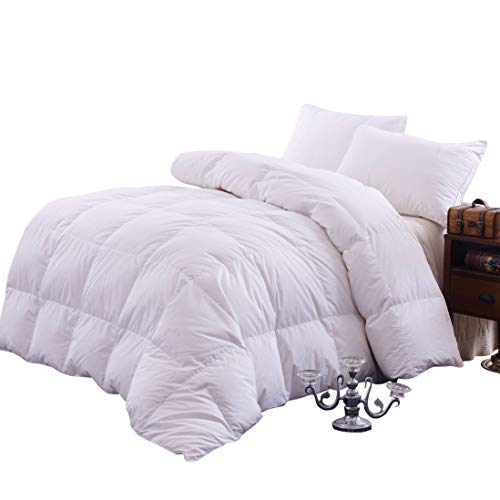
This warm goose down comforter has a cotton cover that’s easy to clean: just pop it into the washer. The size lists as 106 x 90 inches, slightly larger than a standard 90-inch square. It’s substantial if not heavy, and provides enough insulation to keep you cozy in a cold room—or miserable in a cool one.
The filler has nice construction quality using mid-grade down, which provides about 2 inches of loft. Some find it has a slight odor, but there are no major dings. PRO TIP: Safely neutralize down odors by machine washing with a cup of white distilled vinegar.
You aren’t getting hand-combed clusters, but this comforter delivers loft, warmth and economy. This is a good choice for colder climes.
Pros
- High Insulation
- Hypoallergenic
- Durable baffle box design
- Medium Loft
Cons
- Mild Noise
- 50% feather mix
2. ROYALAY ALL SEASONS LIGHTWEIGHT WHITE GOOSE DOWN COMFORTER
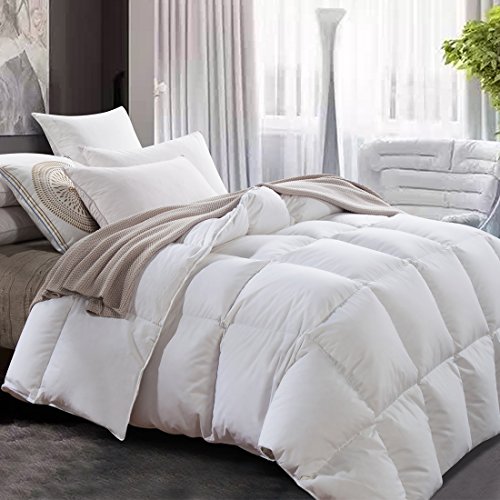
This is a cozy comforter that’s lightweight but still quite warm. The double-stitched, all-cotton cover, rated as 600FP, is attractive and easy to clean. There are Duvet Loops on each corner.
The filler is white goose down with 25% feathers that supply a little extra loft. The construction on this blanket is good, with piped seams and batten-box stitching to keep the down inside. The boxes are fully stitched; though, not very full.
This is a bargain as a warm and comfortable blanket you can throw in the wash now and then. It runs a bit hot for warmer areas, but it’s light so you won’t feel like you’re under a heavy tarp.
Pros
- Durable no-escape construction
- Hypoallergenic
- 600FP Goose Down (25% feathers)
- Pipe seams; double-stitching
Cons
- Mild Noise
3. EASTWARMTH SUMMER SPRING 650+FP WHITE GOOSE DOWN COMFORTER
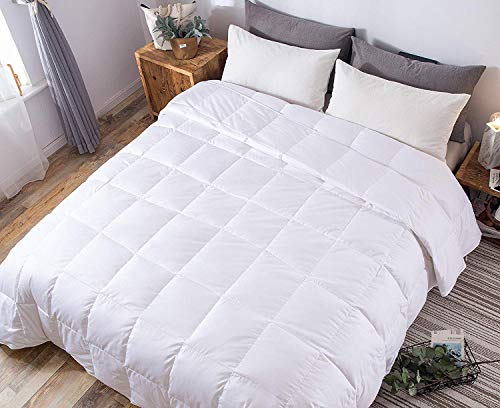
This is a light, airy comforter made with 100% Organic cotton and hypoallergenic white goose down. Weighing less than four pounds, its 650+FP mix provides warmth and loft despite the skimpy filling. The box stitching has piped seams with corner tabs for attaching to a duvet.
The manufacturer recommends dry cleaning only, a little extreme. The filling is distributed well, though there isn’t a whole lot: this is an especially light down comforter.
This is a nice choice for a light cover to keep the chill away on cool nights, but one that lets you breathe, too.
Pros
- Lightweight
- Goose Down (25% feathers)
- 100% Organic Cotton
- Hypoallergenic
- 650+FP
Cons
- Mild Noise
- Low Loft
4. PINZON ALL-SEASON DOWN COMFORTER
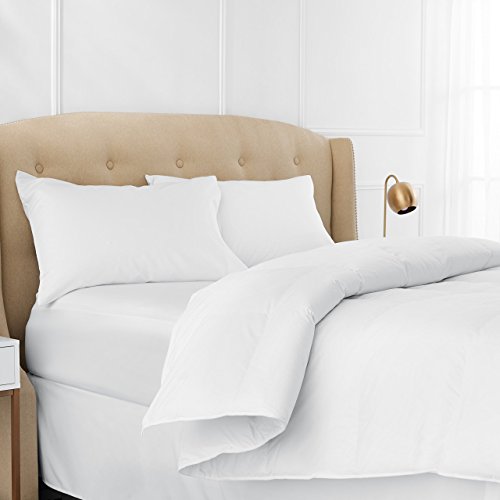
Pinzon is a formerly secret brand of luxury towels and bedding made by tricky, tricky Amazon, and the collection includes a selection of down comforters in the price range we’re reviewing.
The good news is their All-Season comforter doesn’t have any major faults. The 100% Cotton exterior has piped seams and corner Duvet Loops … and includes 2-way snaps so you can add more comforters. This helps with the problem of over-heating, since each comforter is lightweight.
The filling uses inferior duck down and 25% of “something” else. No FP rating is given. The construction is “shed-resistant” to help the tiny feather bits from escaping, which addresses one of the main problems with small feathers and bits. With a bit of luck, you’ll never know how cheap it really is.
This popular Pinzon model satisfies the comfort and light insulation many customers prefer. It’s a good choice as a starter model, and is well-priced as a utility blanket. Also, if you like the brand, there is a wide selection of different blankets and styles.
Pros
- Durable no-escape construction
- 75% Duck Down mix (25% unstated material)
- Baffle box design with Duvet Loops
- 2-way Snaps
Cons
- Mild Noise
- Rough 300 thread-count cover
- Low Loft
- Dry Cleaning recommended
5. PUREDOWN 800FP NATURAL WHITE GOOSE DOWN COMFORTER
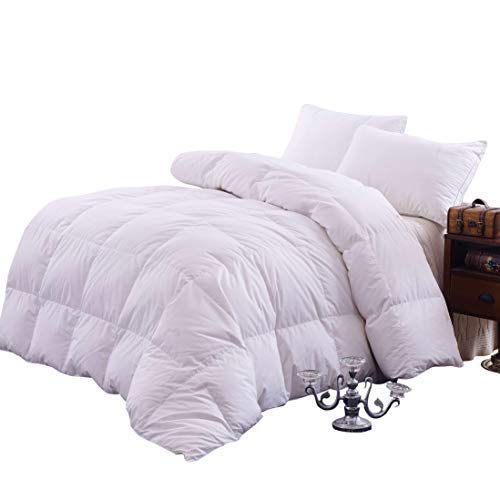
If you’re looking for a marshmallow cloud of a blanket, this medium-heavy Downright comforter has some extra quality for a bit more expense. It’s filled with 93% white goose down mixed with just 7% feathers, and has a 700 thread-count Egyptian cotton cover.
The fill lists as 800FP, which it probably isn’t, but it does deliver comfort and heat aplenty. This isn’t a light blanket, and won’t suit hot sleepers or summertime temps. The quality baffle box construction keeps the feathers in, and Duvet Loops keep the padding in place.
There isn’t a mention of whether the feathers are hypoallergenic—but they do conform to the Responsible Down Standard for humane and environmentally-sound processing.
This is a popular cold-weather comforter with a higher grade of down mix than bargain models. You might want to keep looking if you’re subject to down allergies, but this is a great choice for keeping warm while sleeping in a cloud.
Pros
- 93% 800FP White Goose Down (only 7% feathers)
- 100% 700 thread-count Organic Cotton cover
- Durable baffle box design with Duvet Loops
- Odorless
- Compliant with Responsible Down Standards
Cons
- Higher cost
- Not stated as hypoallergenic
 Best Down Comforters